

TL;DR:
- Graphic minimalism requires high skill to create purposeful, impactful designs with fewer elements.
- Minimalist animal t-shirts convey personality with simple lines, whitespace, and limited colors.
- Balancing clarity and personality is essential to avoid blandness and ensure effective communication.
Graphic minimalism seems like it should be the easiest design approach in the world. Use less, right? But here’s the surprising paradox: stripping a design down to almost nothing actually demands more skill, more intention, and more creativity than piling on details. Every line, every color choice, every bit of empty space has to earn its place. This is especially true in fashion, where a single graphic on a t-shirt either stops people in their tracks or gets ignored entirely. Whether you’re drawn to clean aesthetics, playful animal illustrations, or both, understanding graphic minimalism changes how you see and wear design.
Table of Contents
- Defining graphic minimalism: Principles and methodologies
- Minimalism in fashion: How it revolutionizes graphic t-shirts
- Balancing clarity and creativity: Avoiding minimalism’s pitfalls
- Minimalism vs. maximalism: When ‘less’ or ‘more’ is best
- Graphic minimalism: What most designers overlook
- Bring graphic minimalism into your wardrobe
- Frequently asked questions
Key Takeaways
| Point | Details |
|---|---|
| Intentional simplicity | Graphic minimalism uses only what’s needed for impact and clarity, avoiding clutter. |
| Perfect for playful fashion | Minimalist animal designs create memorable, versatile t-shirts that blend artistry and fun. |
| Balance is crucial | Too much simplicity can weaken a design, so always check if each element serves its purpose. |
| Choose the right style | Minimalist and maximalist approaches suit different moods and messages—pick the one that works for your intent. |
Defining graphic minimalism: Principles and methodologies
Graphic minimalism isn’t just a style trend. It’s a design philosophy built on one core belief: every element you include must serve a purpose. If it doesn’t communicate, guide the eye, or add meaning, it doesn’t belong. This sounds simple, but applying it consistently is genuinely hard.
At its foundation, graphic minimalism emphasizes simplicity, essential elements only, ample whitespace, limited color palettes, clean typography, and clear visual hierarchy to communicate messages effectively without distraction. That definition covers a lot of ground, so let’s break it down into the principles that actually matter in practice.
The core principles of graphic minimalism:
- Simplicity: Reduce visual noise. Only include what’s necessary.
- Whitespace: Empty space isn’t wasted space. It gives the eye room to breathe and directs focus.
- Color restraint: A palette of one to three colors forces intentional choices and creates visual cohesion.
- Clean lines: Sharp, deliberate lines communicate confidence and clarity.
- Visual hierarchy: Size, weight, and spacing guide the viewer’s eye in a specific order.
Core methodologies include purpose-driven design where every element supports the message, strategic use of whitespace, limited colors and fonts, visual hierarchy via size, weight and spacing, and grid systems for alignment. These aren’t optional extras. They’re the structural backbone of minimalist work.
Visual hierarchy deserves special attention. When you limit your palette and remove decorative elements, hierarchy becomes the primary tool for storytelling. A slightly bolder line, a touch more spacing, a single accent color: these small decisions carry enormous weight in a minimalist composition.
“Minimalism is not about making things simple. It’s about making things matter.” This distinction is what separates forgettable designs from ones that stick with you.
Typography also plays a bigger role than most people expect. In a maximalist design, fonts can blend into the visual noise. In minimalism, your font choice is a loud statement. Clean sans-serif fonts tend to dominate minimalist work because they reinforce the overall aesthetic without competing for attention.
If you want to see how these principles translate into wearable art, what makes animal minimalist tees work is a great place to start. The same rules that govern poster design and branding apply directly to the graphic on your chest.
Minimalism in fashion: How it revolutionizes graphic t-shirts
Fashion has always borrowed from fine art and graphic design, but minimalism found a particularly natural home in the graphic t-shirt world. A t-shirt is essentially a canvas with constraints: limited space, a moving surface, and a viewer who has about two seconds to register what they’re seeing.
Minimalist animal designs thrive in this environment. A single-line illustration of a dachshund, a frog drawn with four confident strokes, a cat reduced to its most recognizable silhouette: these designs communicate personality, humor, and warmth with almost no visual clutter. That’s a remarkable feat.

Minimalism suits modern UX and timeless branding because it doesn’t rely on trends. A clean, well-executed animal graphic looks just as fresh in five years as it does today. That’s the versatility argument for minimalism in fashion, and it’s a strong one.
What makes minimalist animal tees stand out:
- Personality captured in a few deliberate lines
- Designs that pair with almost any outfit
- Humor that lands without explanation
- A handcrafted, artisan quality that feels personal
| Feature | Classic animal t-shirt | Minimalist animal t-shirt |
|---|---|---|
| Color count | 4 to 8+ colors | 1 to 3 colors |
| Line style | Detailed, shaded | Clean, single-weight |
| Background use | Filled or patterned | Whitespace-forward |
| Versatility | Occasion-specific | Everyday wear |
| Emotional tone | Literal, descriptive | Playful, interpretive |
| Longevity | Trend-dependent | Timeless |
The table above shows why the minimalist approach wins on nearly every practical measure for everyday fashion. You get more wearability, more versatility, and a stronger emotional punch per square inch of fabric.
Pro Tip: When evaluating a minimalist animal design, cover the background and ask if the graphic alone tells a story. If the answer is yes, the design is working. If it feels empty without context, it needs more intention, not more detail.
For a deep look at how single-line illustration techniques create that signature feel, minimal line animal shirts breaks down the craft beautifully. And if you want a specific case study in personality-driven minimalism, dachshund minimalist design shows exactly how one animal’s character translates into a few perfectly placed lines.
Balancing clarity and creativity: Avoiding minimalism’s pitfalls
Minimalism has a dark side. Push it too far, and you end up with something that communicates nothing. A circle on a white background isn’t minimalist design. It’s just… a circle. The difference between powerful restraint and empty blandness comes down to intention.
Over-simplification leads to blandness or poor communication and requires balance to avoid failing to convey complex ideas. This is especially true for playful or detail-heavy contexts, which is exactly where animal-themed graphics live. A frog needs to feel like a frog, not a vague green blob.
So how do you stay on the right side of that line? Use this checklist before finalizing any minimalist design:
- Does the design communicate instantly? A viewer should understand the subject within one second.
- Does every element serve a purpose? Remove anything that doesn’t contribute to meaning or visual balance.
- Is there enough personality? Especially for animal graphics, the design should feel alive, not sterile.
- Does the whitespace guide the eye? Empty space should direct attention, not just exist by default.
- Would removing one more element break it? If yes, you’ve found the floor. If no, keep editing.
For animal-themed graphics specifically, personality is the hardest thing to preserve through simplification. The quirk of a cat’s expression, the stubby legs of a corgi, the wide-eyed surprise of an owl: these details define the subject. Stripping them away in the name of minimalism defeats the entire purpose.
“The goal isn’t to make something simple. It’s to make something clear.” Clarity and personality can coexist, but it takes more work than most designers expect.
Pro Tip: Try drawing your animal subject with only five lines. If you can capture the essence of the animal in those five lines, you have the foundation of a strong minimalist design. Add back only what’s absolutely necessary after that.
Designs that nail this balance often use irony or humor as a shortcut to personality. A deadpan expression on a very serious-looking cat communicates volumes with almost no visual complexity. Ironic minimalist shirts explore this concept in depth and show how wit can do the heavy lifting that detail usually handles.
Minimalism vs. maximalism: When ‘less’ or ‘more’ is best
Maximalism is minimalism’s loud, unapologetic counterpart. Where minimalism asks “what can we remove?”, maximalism asks “what can we add?”. Both are legitimate design philosophies, but they serve very different purposes and audiences.
Minimalism focuses on clarity with a “less is more” approach, while maximalism embraces vibrant, layered compositions with a “more is more” energy. Minimalism suits modern aesthetics and timeless branding. Maximalism suits celebration, abundance, and sensory-rich experiences.
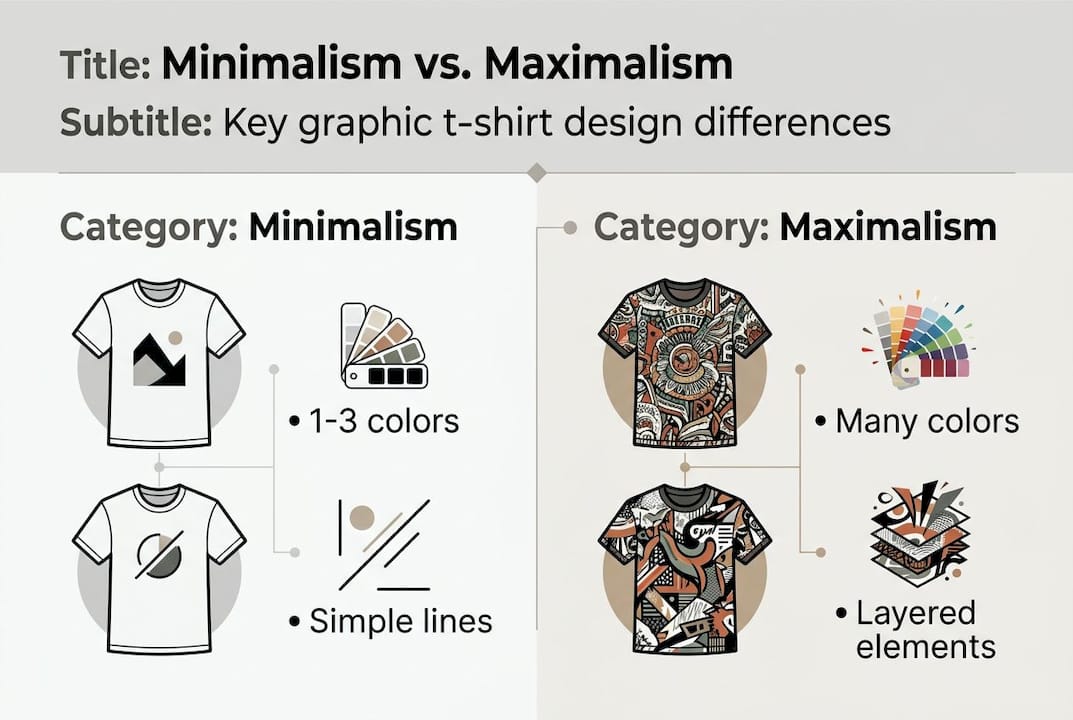
| Dimension | Minimalism | Maximalism |
|---|---|---|
| Core philosophy | Less is more | More is more |
| Color use | 1 to 3 colors | Unlimited, often clashing |
| Emotional effect | Calm, focused, clever | Energetic, overwhelming, joyful |
| Versatility | High | Low to medium |
| Design complexity | Low | High |
| Best for | Everyday wear, branding | Statement pieces, events |
| Longevity | Timeless | Trend-dependent |
When to choose minimalism:
- You want a design that works across multiple contexts
- The subject has strong inherent personality (like animals)
- You’re building a wardrobe staple, not a statement piece
- You want the design to age well
When maximalism might win:
- You’re designing for a specific event or moment
- The goal is visual spectacle over wearability
- Your audience expects richness and detail
For animal graphic tees, minimalism wins almost every time. The personality of the animal does the emotional work, and clean execution lets that personality breathe. A maximalist animal design often competes with itself, with too many details fighting for attention and the core charm of the animal getting lost in the noise.
If you’re building a wardrobe around this aesthetic, styling minimalist graphic tees gives you practical guidance on how to make these pieces work in real outfits.
Graphic minimalism: What most designers overlook
Here’s the uncomfortable truth most design guides won’t tell you: minimalism is harder than maximalism. Anyone can add more. Removing elements until only the essential ones remain, and having those elements still communicate powerfully, that’s a genuine test of creative skill.
Minimalism demands more intentionality than complexity because stripping elements reveals whether a design truly works. When you can’t hide behind detail, every choice is exposed. This is why so many minimalist designs fail. They remove the clutter but forget to keep the soul.
For animal tees specifically, this means the illustrator must understand the animal deeply enough to capture its essence in almost nothing. A frog minimalist shirt that works isn’t just a simplified frog. It’s a frog that somehow feels more like a frog than a photorealistic rendering would. That’s the magic of true minimalism: reduction reveals character rather than erasing it.
What you leave out is just as important as what you keep. The empty space around a tiny, perfectly drawn animal isn’t wasted. It’s doing real design work, creating focus, building tension, and letting the personality of the subject land without competition. Most people see minimalism as a style choice. The best designers know it’s a creative discipline.
Bring graphic minimalism into your wardrobe
Now that you understand the art and science behind graphic minimalism, here’s where you can see it in action and maybe wear it, too.
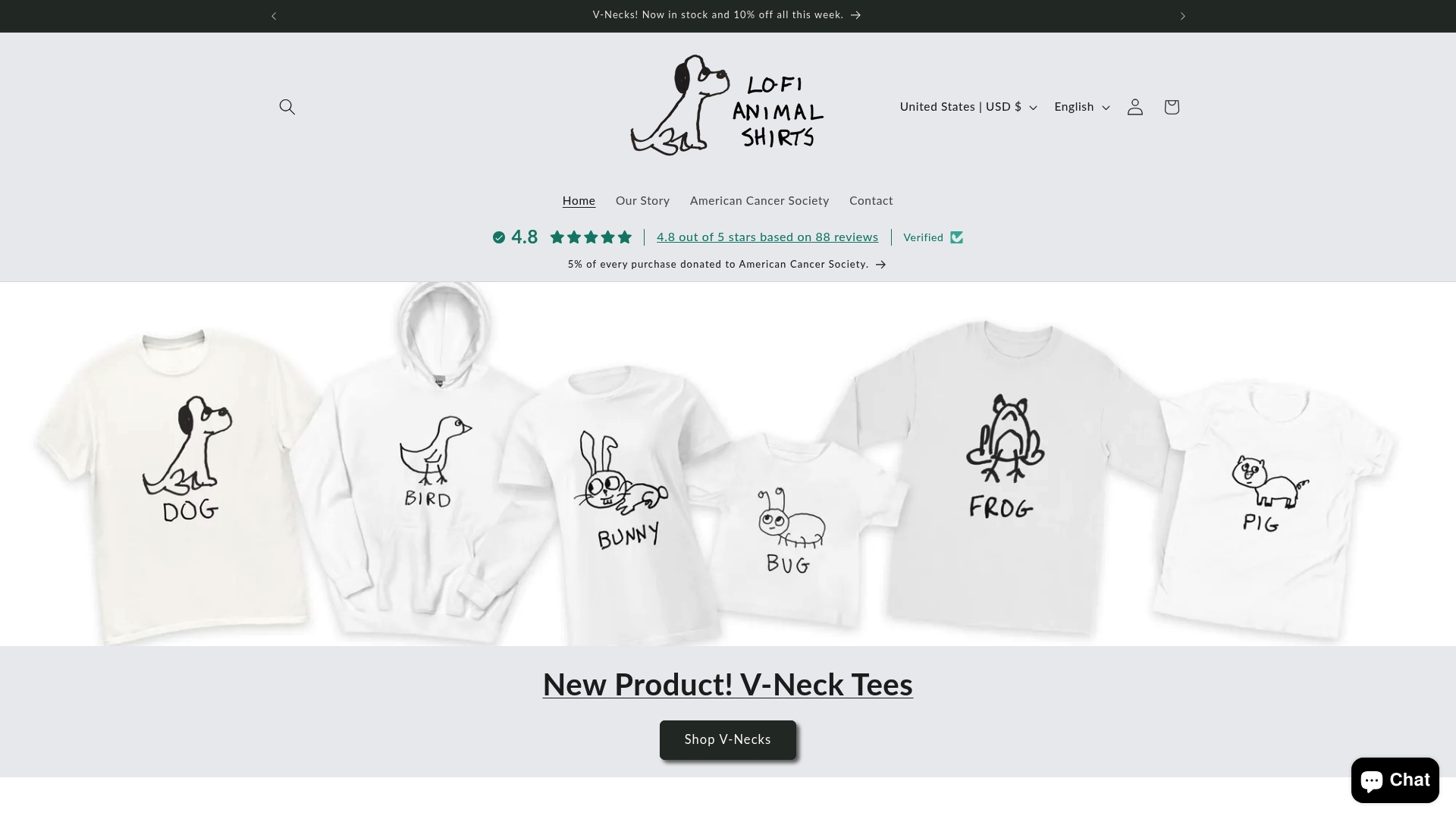
At Lofi Animal Shirts, every design is built on the principles we’ve covered here: intention, restraint, personality, and just enough detail to make you smile. The minimalist elephant sweatshirt captures the gentle weight of an elephant in a handful of confident lines, while the minimalist dog sweatshirt turns pure canine joy into something you can wear every day. These aren’t just graphic tees. They’re proof that the right line in the right place can say everything. Browse the full collection and find the animal that speaks to you.
Frequently asked questions
What are the main elements of graphic minimalism?
Graphic minimalism uses essential elements only, with ample whitespace, limited colors, clean typography, and clear visual hierarchy to direct the viewer’s attention without distraction.
Why do minimalist animal graphic tees look so appealing?
Minimalist animal tees use uncluttered lines and limited colors, letting the animal’s personality shine through while staying versatile enough to pair with almost any outfit in your wardrobe.
Can graphic minimalism be too simple?
Yes. Over-simplification leads to blandness or poor communication, especially when the design needs to convey playfulness or character, which is why balance and intention matter so much.
How is minimalism different from maximalism in graphic design?
Minimalism focuses on fewer elements for clarity and timeless appeal, while maximalism layers color, texture, and detail to create vibrant, energetic compositions that prioritize visual richness over restraint.
Recommended
- How to Wear Minimalist Graphic Tees Well – LoFi Animal Shirts
- Why Minimalist Graphic Hoodies Work – LoFi Animal Shirts
- Minimalist Animal Graphic Tees, Explained – LoFi Animal Shirts
- Minimalist Frog T Shirt, Done Right – LoFi Animal Shirts
- Urban fashion style guide: elevate your minimalist streetwear – Klepsa
- Street fashion types: Japanese minimalism & modern styles – INCIDENT
Leave a comment